Duramont Ergonomic Office Chair Review
The lumbar pad on this chair moves four ways, not two, which is the difference between a chair that fits your back and one you fit yourself around.
Most chairs in this price range bolt on a fixed foam hump and call it lumbar support. The Duramont’s pad slides up, down, in, and out, so it can actually find the curve of your lower spine instead of pressing wherever the manufacturer guessed it should. This one’s aimed at people doing 6-9 hour desk days who’ve outgrown a flat-pack mesh chair but aren’t ready to spend $900+ on a Herman Miller.
- 4D lumbar is the headline feature The pad adjusts on four axes (height, depth, and side-to-side pivot), letting you dial in support for your specific lower back curve rather than settling for a one-size pad.
- Recline isn't binary Unlike chairs that only go from upright to full recline, this one offers multiple locking angles plus a separate tilt-tension knob, so you can set resistance for your body weight.
- Rated for 350 lbs on a reinforced base The aluminum base and caster setup are built past the seat size would suggest, making it one of the sturdier options at this price point for larger users.
- Assembly is real but manageable It ships in pieces requiring an 8-step build; budget 25-40 minutes with the included tools rather than the 10 minutes some listings imply.
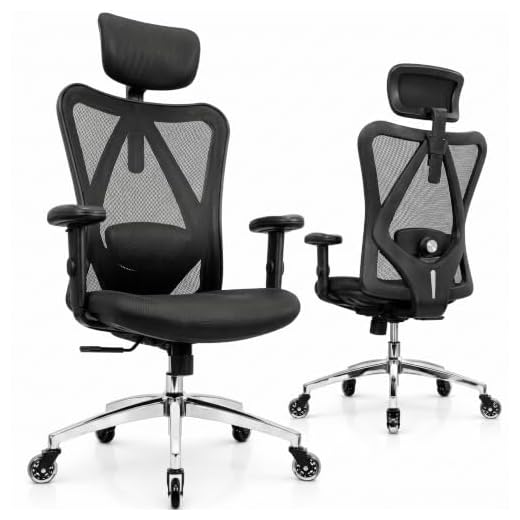
4D lumbar support moves up, down, in, and out to match your exact spine curve, while memory foam and breathable mesh keep you supported and cool through long workdays.
| Lumbar Support | 4D adjustable (up/down, in/out) |
| Recline | Multi-angle recline with adjustable tilt tension |
| Armrests | Height-adjustable |
| Headrest | Adjustable height and angle |
| Seat Material | Molded memory foam cushion |
| Backrest Material | High-density breathable mesh |
| Base | Reinforced aluminum, 5-star |
| Casters | Rollerblade-style wheels |
| Weight Capacity | 350 lbs |
| Warranty | 5 years |
| Assembly | 8-step, tools included |
- 4D lumbar adjustment actually locates your lower back curve instead of pressing a generic spot
- Separate tilt-tension knob lets you match recline resistance to your body weight, not just pick an angle
- Memory foam seat holds its shape after months of daily use better than the cheap molded foam in sub-$150 chairs
- 350 lb weight rating with an aluminum base feels genuinely more stable than the plastic bases common in this price bracket
- Rollerblade-style casters roll smoothly and quietly on hardwood and laminate
- Armrests adjust for height only, not width or pivot, so narrow-shouldered or very broad users may still find them slightly off
- Mesh backrest runs firmer than foam-backed chairs, which some users read as supportive and others as just stiff after long sessions
- Rollerblade wheels that excel on hard floors can feel sluggish or catch slightly on thick carpet without a chair mat
Choosing the right ergonomic office chair
-
Lumbar adjustment rangeHighA fixed lumbar bump only fits the one body shape it was designed around. Chairs that let the pad move on multiple axes adapt to a wider range of torso lengths and curves.Look forLumbar support that adjusts on at least two axes (height and depth), ideally fourAvoidNon-adjustable foam humps molded directly into the backrest
-
Recline mechanism and tension controlHighLocking at just one or two recline positions forces everyone into the same posture. A separate tension knob lets heavier and lighter users both get resistance that feels right.Look forMultiple lockable recline angles plus an independent tilt-tension adjustmentAvoidChairs that only toggle between upright and full recline with no tension control
-
Weight capacity vs. actual base constructionMediumA listed weight rating is only as good as the base and casters backing it up. A 350 lb rating on a reinforced aluminum frame holds up differently than the same number on a plastic base.Look forMetal (steel or aluminum) base construction paired with a weight rating that matches or exceeds your needsAvoidHigh weight claims on chairs with plastic bases and no mention of frame material
-
Seat material: foam density vs. meshMediumLow-density foam compresses and goes flat within a year of daily use; mesh seats stay supportive longer but feel firmer from day one.Look forMemory foam or high-density foam described with specific thickness, or a taut seat mesh with a rated weight capacityAvoidVague 'cushioned' descriptions with no foam density or thickness specified
-
Caster type matched to your flooringLowStandard hard casters grip carpet but scratch and drag on hardwood or laminate; soft rollerblade-style wheels do the opposite.Look forCaster material that matches your actual floor, or a chair that ships with swappable caster optionsAvoidAssuming all casters perform the same regardless of flooring type
Common questions
Is the 4D lumbar support hard to adjust, or is it a set-it-once-and-forget-it feature?
It’s a quick manual adjustment, not motorized, so you move the pad by hand to find your spot and it stays put. Most owners dial it in within the first week and rarely touch it again unless multiple people share the chair.
How long does the 8-step assembly actually take?
Budget 25-40 minutes for one person working alone with the included tools. The steps themselves are straightforward (base, casters, seat, back, arms, headrest), but torquing all the bolts properly on the aluminum base takes longer than a flat-pack bookshelf.
Will this chair work for someone over 250 lbs?
Yes, it’s rated to 350 lbs and the reinforced aluminum base is built to back that number up, which puts it above most chairs in its price class that top out around 250-275 lbs. If you’re near the upper end of that range, it’s worth checking the seat width and depth against your frame before buying.
Does the mesh back make it too cold or too firm compared to a padded chair?
The mesh runs firmer than a foam-backed chair, which is the tradeoff for the airflow that keeps your back from sweating during long sessions. People coming from plush office chairs sometimes need a week to adjust to the firmer feel before they notice the temperature benefit.
The 4D lumbar adjustment and separate tilt-tension knob set this chair apart from the crowd of fixed-recline mesh chairs at a similar price. The armrests only move up and down rather than pivoting or sliding, and the mesh back takes some adjusting to if you’re used to padded backrests, but the build quality on the base and casters holds up to daily 350 lb-rated use. For anyone replacing a basic desk chair because of lower back discomfort, this is a legitimate upgrade rather than a cosmetic one.
- 4D lumbar support and a separate tilt-tension knob give more real adjustment than most chairs in its price range
- 350 lb capacity on a reinforced aluminum base makes it a solid pick for larger users or shared households
- Breathable mesh back and memory foam seat balance airflow with pressure relief for long desk sessions
The Duramont earns its place for anyone whose current chair has a fixed lumbar pad that never quite lines up with their lower back. It costs more than a bargain-bin mesh chair but delivers adjustment points that actually matter for posture over an 8-hour workday, backed by a 5-year warranty that signals real confidence in the build.