Why your afternoon slump might be a ventilation problem
That 2 PM wall of brain fog isn't always sleep debt or a bad lunch—it's often 1,500+ ppm of CO2 you can't smell or see.
Cognitive testing shows decision-making and complex reasoning drop off measurably once indoor CO2 climbs past 1,000 ppm, which happens fast in a closed-door office or a conference room full of people. The gap between a good monitor and a bad one comes down to sensor type: NDIR (non-dispersive infrared) sensors hold their calibration for years and read accurately, while the cheap electrochemical or estimated-CO2 sensors in many budget air quality gadgets drift within months and just guess based on VOCs.
- NDIR sensors are non-negotiable Any monitor without a true NDIR sensor is estimating CO2 from other pollutants, not measuring it—those numbers aren’t reliable enough to act on.
- 1,000 ppm is the focus threshold Alertness and decision-making measurably decline above 1,000 ppm CO2, and most closed offices cross that line within an hour without fresh air.
- Placement matters as much as the device Desk-height, away from your own exhaled breath and at least a few feet from windows or vents, is where a monitor gives you numbers you can trust.
- Data history beats a single reading A live number tells you it’s stuffy right now; days or weeks of logged history tell you when and why it happens, so you can actually fix your routine.



Best Overall: Aranet4 Indoor Air Quality Monitor
Real-time CO2, temperature, humidity and pressure readings plus 90 days of app history help you catch stuffy-office CO2 spikes before they sap focus—n
- Genuinely portable—no outlet needed, so it can sit on a conference table or move between desks
- E-ink screen stays readable and doesn’t wash out under office lighting
- Bluetooth history syncs to the app without you having to babysit it
- Widely used as a reference device by HVAC techs and air quality researchers, so the numbers hold up
- $189 is a real premium over plug-in alternatives
- No built-in audible alarm—you have to glance at it or check the app
- App history caps at 90 days without a subscription
Best Premium: CO2Meter AZ-0004 Indoor Air Quality CO2 Meter
Plugs straight into the wall and self-calibrates, giving a maintenance-free, always-on CO2 reading so afternoon brain fog gets caught the moment level
- Auto-calibration means no manual recalibration routine to forget about
- Always-on since it’s wall-powered—no battery to die mid-meeting
- Data-logging output makes it usable for real facilities audits, not just casual checking
- Large, clear digital readout works from across a conference room
- Needs a wall outlet, so placement is fixed once installed
- Bulkier, more institutional look than consumer air monitors
- No mobile app—readings are on-device or via logged export only
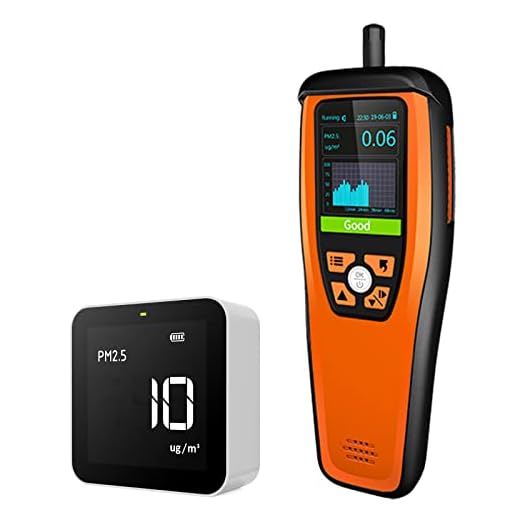
Best for Multi-Pollutant Tracking: Temtop M2000C 2nd+ P10
Combines an NDIR CO2 sensor with laser PM2.5/PM10 and HCHO detection, exporting months of data via USB so you can prove which pollutant is behind slug
- Catches particulate and formaldehyde issues that a CO2-only monitor would completely miss
- USB export lets you build months of logs for troubleshooting a specific room
- Audio alarm flags spikes even when you’re not looking at the screen
- One unit replaces what would otherwise be two or three separate sensors
- More menus and settings to learn than a single-purpose CO2 monitor
- Larger footprint than dedicated CO2-only devices
- Laser PM sensor adds a component that needs occasional cleaning to stay accurate
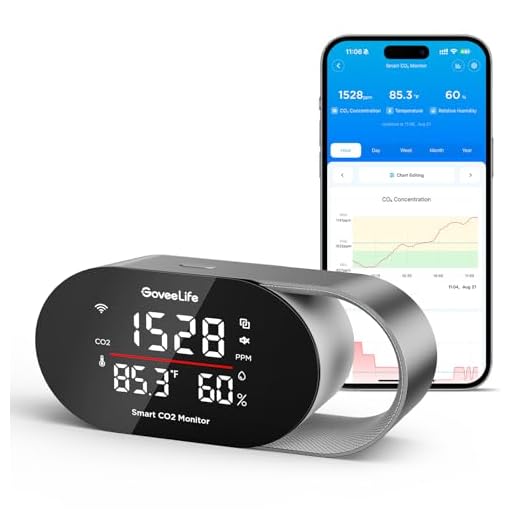
Best for Smart Home Integration: GoveeLife Smart Air Quality Monitor H5140
SCD4x sensor delivers CO2 readings every 5 seconds with app alerts, buzzer and email warnings the instant levels rise—so drowsiness gets flagged befor
- 5-second sensor refresh is fast enough to catch spikes as a door closes or a meeting fills a room
- Push notifications and email alerts mean you don’t need to be at your desk to get warned
- Up to two years of stored history makes long-term pattern spotting easy
- $89.99 undercuts most NDIR competitors while still using a respected sensor
- Requires the Govee app and account to unlock alerting and history features
- Buzzer alarm can be jarring in a shared or quiet office
- Wi-Fi dependency means outages or router issues interrupt remote alerts
Best Budget: Mini CO2 Detector, Stylish and Lightweight
Pocket-sized CO2 alarm that alerts past 1000ppm and runs 48 hours on a USB charge, making it an easy grab-and-go check for stuffy meeting rooms or hom
- Small enough to toss in a bag and use in any meeting room or coworking space
- USB charging means no proprietary cables or disposable batteries
- Covers the practical 400-5,000 ppm range most home offices actually hit
- Lowest price point of the group by a wide margin
- No app, no data logging—just a live number and an alert
- 48-hour battery life means more frequent charging than the Aranet4’s years-long runtime
- Sensor accuracy and long-term calibration aren’t documented to the same standard as the pricier NDIR units
Side-by-side comparison
|
Best Overall
Aranet4 Indoor Air Quality Monitor, Wireless CO2 D
|
Best Premium
CO2Meter AZ-0004 Indoor Air Quality CO2 Meter, Tem
|
Best for Multi-Pollutant Tracking
Temtop M2000C 2nd+ P10 Air Quality Monitor Combo,
|
Best for Smart Home Integration
GoveeLife Smart Air Quality Monitor CO2 Detector H
|
Best Budget
Mini CO2 Detector, Air Quality Monitor, Stylish an
|
|
|---|---|---|---|---|---|
|
|
|
|
|
|
|
| Sensor Type | NDIR | Self-calibrating NDIR | NDIR + laser PM | SCD4x NDIR | NDIR-based |
| Power Source | Battery (up to 4 yrs) | Wall plug | Rechargeable/plug-in | USB/Wi-Fi powered | USB rechargeable (48 hrs) |
| Data History | 90 days (app) | Logged output (export) | USB export, months | Up to 2 years (app) | None |
| Alerts | Visual (e-ink) | Visual display | Audio alarm | App, email, buzzer | Audio alarm (1000ppm) |
| Price | $189.00 | – | – | $67.99 | – |
| BUY NOW | BUY NOW | BUY NOW | BUY NOW | BUY NOW |
What to look for in CO2 Monitors for Office Focus and Alertness
What CO2 level actually starts hurting focus and alertness?
Cognitive studies show measurable declines in decision-making and complex thinking starting around 1,000 ppm, with more pronounced effects above 1,400 ppm. Outdoor air is roughly 420 ppm, so a closed office climbing past 1,000 ppm within an hour is common and worth acting on.
Do I need NDIR, or is a cheaper VOC-based sensor good enough?
For anything you plan to act on, get NDIR. VOC-based ‘eCO2’ sensors estimate CO2 from unrelated compounds in the air and can be off by hundreds of ppm, which defeats the purpose of tracking focus-killing spikes accurately.
Where should I place a CO2 monitor in an office for accurate readings?
Desk height, a few feet away from your face so you’re not measuring your own exhaled breath, and away from windows, doors, or air vents that create artificial swings. Give it a few minutes to stabilize after moving it.
Will opening a window or door actually fix high CO2 readings?
Yes—cracking a window or door for even 5-10 minutes noticeably drops CO2 in a typical office or home workspace, since you’re diluting with outdoor air at roughly 420 ppm. A monitor with fast refresh, like the GoveeLife’s 5-second SCD4x readings, lets you see that drop happen in real time.
The bottom line
- Aranet4 Indoor Air Quality Monitor: the most trusted sensor and battery life in a portable package, worth the $189
- CO2Meter AZ-0004: self-calibrating and always-on, built for permanent installation in shared spaces
- Temtop M2000C 2nd+ P10: the pick when you need to rule out PM2.5, PM10, or HCHO alongside CO2
- GoveeLife H5140: fast SCD4x readings with phone alerts, best for smart-home-first households
- Mini CO2 Detector: a no-frills, USB-rechargeable way to catch stuffy rooms without spending pro-monitor money
For most home offices, the Aranet4 earns its price with battery-free convenience and sensor accuracy that won’t drift. If you’re monitoring a shared or fixed space full-time, the wall-powered CO2Meter AZ-0004 is the more durable choice, and the Mini CO2 Detector is the honest budget entry point if you just want a warning light.