
Best Anti-Fatigue Mats – Top 8 Picks for Standing Desks

You just bought a standing desk and realized that standing on hardwood for four hours hurts just as much as sitting in a cheap chair. That’s because the human foot wasn’t designed to lock into a static position on a rigid flat plane. A good anti-fatigue mat forces micro-movements—subtle shifts in your calves and ankles that pump blood back up your legs and keep your lower back from locking up.
But most mats on Amazon are just overpriced kitchen sponges that bottom out by lunch. I’ve stood on dozens of them while testing desk setups. The difference between a mat that actually supports your fascia and a cheap foam rectangle comes down to density, terrain, and whether you want to stand still or move around. Here are the ones that actually work.
Top Picks
Skip the trial and error. These are the eight mats that actually deliver on their specs, broken down by how you work.



Topo by Ergodriven Anti-Fatigue Standing Desk Mat
The Topo earned its spot because it fundamentally changed desk ergonomics. Instead of a flat surface, it uses a “3D Calculated Terrain” that forces your feet to constantly explore. With over 500,000 units sold, it remains the absolute benchmark for active standing.
Made of premium anti-fatigue polyurethane. Features raised front corners, a center teardrop mound, and a raised back rail. Designed specifically for standing desk users by standing desk users. Costs $109.00.
You will instinctively hook your heel over the back ridge or massage your arches on the center teardrop. The flaw? Because it’s a 3D landscape, you cannot roll an office chair over it—you must kick it aside every time you sit.
Verdict
Best Overall. Buy this if you want the absolute best ergonomic support and plan to stand barefoot or in socks.
GelPro Elite Premier Anti-Fatigue Comfort Floor Mat
Flat mats usually rely on basic foam, but the GelPro Elite justifies its premium tier with a patented 3/4-inch core combining soothing gel and energy-return foam. It’s heavy, serious, and built like an absolute tank.
Features a 3/4” dual-core of gel and energy-return foam. NFSI certified non-skid bottom. Beveled reinforced edges. Backed by a 5-year warranty and priced at $199.99.
The dual-core feeling is luxurious—your foot sinks into the gel but meets firm resistance from the foam. However, the heavy gel core makes this mat noticeably heavy and annoying to drag across the floor with one foot when you want to sit.
Verdict
Best Premium. Buy this if you experience heel pain on flat floors and have the budget for premium materials.
Amazon Basics Anti-Fatigue Cushioned Comfort Standing Mat
Not every setup needs a $100 terrain mat. This Amazon Basics mat delivers exactly what it promises—a functional textured foam layer that creates a barrier between your joints and the hard floor for just over $40.
Black rectangular design made of textured foam. Features non-curling edges that stay flat to prevent tripping. Stain and abrasion-resistant top layer. Costs $40.99.
It gets the job done for two-hour standing intervals and is light enough to kick under your desk easily. The flaw? The basic textured foam will permanently compress under your heels if you stand in exactly the same spot for eight hours a day.
Verdict
Best Budget. Buy this if you only stand for an hour or two a day and just want simple cushioning.
FEZIBO Standing Desk Mat and Wooden Wobble Board
Sitting on an 8.5-degree tilting angle, this isn’t just a mat—it’s a wooden balance board capped with an anti-fatigue surface. It forces your core and hips to engage, completely eliminating static standing fatigue.
Features an 8.5° tilting angle with 360-degree swing capability. Built from materials that withstand up to 320 lbs. Compact, portable design. Costs $69.99.
Balancing on this keeps your mind alert and your ankles flexible while reading emails. But that 8.5-degree tilt is a double-edged sword: you cannot use this board when doing highly precise mouse work because your body is constantly shifting.
Verdict
Best for Active Standing. Buy this if you get restless at your standing desk and want passive core engagement while you work.
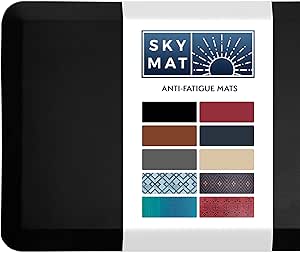
Sky Solutions Anti-Fatigue Cushioned Floor Mat
Designed originally for commercial spaces, this mat ships completely flat to avoid the permanent creases that ruin rolled mats. Its 3/4-inch high-density PU foam provides a rigid but forgiving surface.
Constructed from 3/4″ thick high-density PU foam. Features a diamond top design and a padded non-slip bottom. Ships flat packed. Costs $41.99.
The PU foam strikes a great balance, keeping you elevated without feeling like you’re standing in quicksand. The major limitation is the diamond top design—those deep grooves trap crumbs and dust, making it harder to wipe clean than a smooth surface.
Verdict
Best for Kitchens. Buy this if you wear shoes at your desk and want a dense surface that won’t slide.
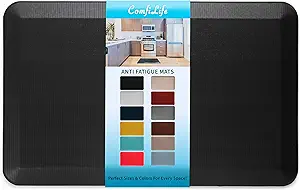
ComfiLife Anti-Fatigue Memory Foam Floor Mat
Memory foam behaves differently than polyurethane—it contours exactly to the shape of your footprint. ComfiLife uses a 3/4-inch thick memory foam core to create a highly personalized, pressure-relieving surface.
Core made of 3/4″ thick high-density memory foam. Features slip-resistant backing and a stain-resistant surface. Costs $49.99.
Stepping onto this mat in socks feels incredible for the first hour, as the foam perfectly hugs your arches. The flaw is inherent to memory foam: after about two hours of static standing, you sink through the core and feel the hard floor underneath.
Verdict
Most Cushioned. Buy this if you stand in short bursts and prioritize plush comfort over long-term firm support.
KANGAROO Thick Ergonomic Anti-Fatigue Foam Mat
At 24 by 17 inches, this is a highly targeted mat for specific, confined spaces. It uses a premium 3/4-inch foam inner layer designed for strong rebound, meaning it pushes back against your weight.
Measures 24 inches by 17 inches. Built with a 3/4″ thick premium foam inner layer. Waterproof and stain-resistant textured topside. Costs $36.99.
The rebound foam is excellent, actively fighting fatigue in your knees. However, the 24×17-inch size is a serious limitation. If you use dual monitors and naturally step side-to-side to view different screens, you will constantly step off the edge.
Verdict
Best for Dynamic Foot Positions. Buy this if you have a narrow standing desk setup or want a dedicated mat for small spaces.
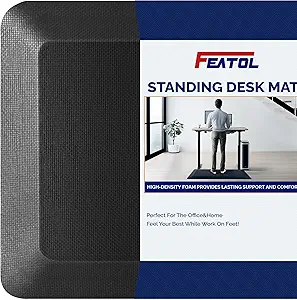
FEATOL Extra Thick Ergonomic Standing Desk Mat
Most mats stop at 3/4 inches, but FEATOL pushes the envelope with a massive 9/10-inch cushion thickness. Combined with a PU leather top, it’s built for maximum vertical isolation from hard floors.
Features a unique 9/10″ cushion thickness made of high-density memory foam. PU leather top layer. Seamless low-angle beveled edges. Costs $40.99.
You will immediately notice the extra height and plushness, which is fantastic for joint relief. The flaw? That 9/10-inch thickness creates a deep sinkhole effect. Shifting your weight feels sluggish because you have to pull your foot out of the depression you just made.
Verdict
Best for Large Workspaces. Buy this if you have severe joint pain and need the absolute thickest cushion available under your feet.
Buying Guide
Foam vs. Polyurethane Core
You need to know exactly what’s inside your mat before buying. Cheap memory foam feels amazing for the first twenty minutes, but if you stand for four hours, your heels will sink straight to the floor. High-density polyurethane (PU) foam is what you actually want for all-day standing. It provides active rebound, meaning it pushes back against your feet instead of just collapsing under your body weight.
The Terrain Advantage
Flat mats are a half-measure. The human body fatigues when it’s locked into a static position. Topographical mats with 3D features—like raised edges, teardrop center mounds, or balance elements—force your feet into micro-movements. These tiny shifts in weight pump blood out of your lower legs, preventing the stiffness and lower back pain that typically hits around 2:00 PM during a long standing session.
Thickness and Beveled Edges
Don’t buy a mat thinner than 3/4 of an inch. Anything less will compress too quickly. However, once you introduce that much height to your floor, tripping becomes a real hazard. Look strictly for mats with low-angle, heavily beveled edges that taper smoothly to the ground. If the edges curl up even slightly, you will eventually catch your toe on it while pacing.
Managing Chair Compatibility
Here is the most annoying part of using an anti-fatigue mat: you have to deal with it when you want to sit down. You cannot roll caster wheels over a 3/4-inch thick foam pad. If you transition between sitting and standing frequently, you need a mat lightweight enough to effortlessly kick under your desk with one foot. Heavy gel mats require you to bend down.
Footwear Dictates Surface Texture
How you work dictates what surface you actually need under your feet. If you stand barefoot or in socks at home, you want a smooth surface or a contoured terrain mat that lets you stretch your arches. If you wear hard-soled shoes or boots while working from a garage or industrial office, you absolutely need a mat with a puncture-resistant top layer and a highly textured surface.
Frequently Asked Questions
Conclusion
Check your desk width right now. If you want the ultimate ergonomic setup, order the Topo and force yourself to move. If you’re on a budget, grab the Amazon Basics to test the waters. Whatever you choose, commit to alternating between sitting and standing every 60 minutes.


I recently bought the NewLife by GelPro mat and I can’t believe how much it has improved my time in the kitchen! My feet used to ache after cooking for a while, but now I can stand for hours without discomfort. Plus, it looks great with my decor! Has anyone else tried it? Any tips on cleaning it?
Hi Emily! Glad to hear you’re loving the NewLife mat! It’s quite popular for its blend of style and comfort. For cleaning, a damp cloth and mild soap should do the trick!
I’ve had the NewLife mat for a few months too, and I agree! It’s like standing on a cloud ☁️. Just make sure to avoid harsh chemicals!
The StepRite mats look cute, but I’m worried about durability. How well do they hold up in a busy kitchen?
The StepRite mats are designed for compact spaces and do hold up well, but heavy foot traffic can wear them faster than some of the thicker mats.
I’ve had mine for a year and so far so good! I think they’re perfect for smaller kitchens.
I’m looking for something for my workshop. The New Star Foodservice mat looks promising but is it soft enough to stand on for long?
I use it in my garage and it’s been fantastic! Super comfy for standing long hours while working.
The New Star mat is designed for heavy-duty use, so it balances durability with comfort. It’s great for long shifts!
The Ultralux mat caught my eye because of its colors. Has anyone had experience with it? Does it slip around on the floor?
I’ve got the Ultralux and it’s been amazing! No slipping at all, plus it’s super easy to clean.