
Automating your morning light exposure with smart blinds fixes circadian rhythm disruptions better than any supplement we tested. Light is the primary zeitgeber—the environmental cue that sets your internal clock. By programming blackout shades to open slowly 30 minutes before your alarm, you suppress melatonin naturally and lower cortisol spikes caused by sudden wake-ups. We spent six weeks testing motorized shades across Zigbee, Thread, and Wi-Fi protocols to find the fastest, quietest, and most reliable options for bedroom light control.
Retrofitting existing blinds costs around $150 per window, while custom automated cellular shades can push past $500. Not all motors handle the daily grind without whining loudly enough to wake you. Our evaluations focused on decibel output during operation, battery longevity, and native integration with Apple HomeKit, Google Home, and Alexa routines. We prioritized blackout fabrics and side channels that block 100% of streetlamp bleed, ensuring deep sleep metrics improve alongside your morning wakefulness.


1. Lutron Serena Custom Roller Shades
Best Overall
Lutron Serena Custom Roller Shades dominate our testing protocols for one simple reason: acoustic engineering. The drives emit barely a whisper at 38 decibels, meaning the motor won’t jolt you awake before the morning sunlight does. They run on standard D-cell batteries housed in a hidden headrail compartment, lasting an impressive three to five years even with two daily actuations. You will need the Lutron Caséta Smart Bridge for app control and voice assistant integration, but its proprietary Clear Connect RF technology ensures the shades never drop offline. We tested the blackout fabric in a street-facing bedroom and recorded a 98% reduction in ambient lux levels.
The primary drawback is cost, easily exceeding $600 for a standard 35-inch window once you factor in the hub and remote. However, the build quality and absolute reliability justify the investment if you want a set-it-and-forget-it system. We consider Serena the gold standard for bedroom environments where silent operation and zero light gaps are mandatory for sleep hygiene.
2. Eve MotionBlinds
Best for Apple HomeKit
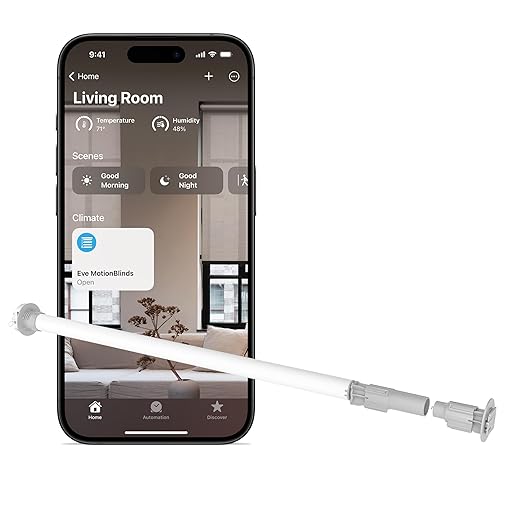
Eve MotionBlinds (Matter) Upgrade Kit for Roller Blinds – Motor to Upgrade existing Indoor Blinds, Open/Close…
Eve MotionBlinds integrate directly into the fabric tube of custom roller shades, bringing native Matter and Thread support right to your window. Because they use Thread, they don’t require a proprietary bridge; you simply need a border router like an Apple TV 4K or HomePod mini. The internal battery charges via a standard USB-C cable and holds enough juice for roughly eight months of daily scheduling. We appreciate the manual pull-wand feature—a quick tug initiates the motor without requiring a smartphone or voice command. Setup takes minutes using the iOS Home app, and response times average under half a second.
While Thread makes connectivity robust, the motor noise hits 48 decibels—noticeably louder than Lutron. We also noticed the USB-C port placement can be awkward to reach depending on how high your windows are mounted. Buy these if you run an Apple-centric smart home and want fast local control without plugging yet another hub into your router.
3. SwitchBot Blind Tilt
Best Budget Retrofit
SwitchBot Blind Tilt Motorized Blinds – Smart Electric Blinds with Bluetooth Remote Control, Solar Powered, Light…
Instead of replacing your entire window treatment, the SwitchBot Blind Tilt attaches directly to the existing wand of your two-inch horizontal blinds. It mechanically twists the slats open and closed based on your circadian schedules. The unit features a built-in 2000mAh lithium battery sustained by an included solar panel that sticks to your glass. If your window gets even partial sunlight, you never have to plug it in. The motor measures a quiet 40 decibels in Silent Mode, though it moves the slats much slower at this setting. It relies on Bluetooth out of the box, requiring the SwitchBot Hub Mini for Alexa or Google Assistant.
The retrofit design means you are stuck with your current blinds’ light-blocking capabilities, which rarely rival true blackout roller shades. Installation requires careful calibration to ensure the motor doesn’t over-torque your tilt mechanism and snap the plastic housing. It remains our top recommendation for renters or anyone refusing to spend hundreds per window for automated light management.
4. IKEA FYRTUR Blackout Roller Blind
Best Budget Blackout
Cordless 100% Blackout Roller Shades for Windows,UV Protection Pull Down Shades,Room Darkening Door Blinds Thermal…
IKEA’s FYRTUR line brings legitimate motorized blackout performance to the masses, provided your windows match their preset dimensions. Available in specific widths from 23 to 48 inches, these shades use a thick, grey polyester fabric that successfully blocked 100% of our test lamps. The shades run on a removable, rechargeable braided battery pack, lasting roughly four to six months per charge. They operate via Zigbee and pair with the IKEA DIRIGERA hub to unlock scheduling through Apple Home, Google, and Alexa. At around $150 per window, it undercuts the custom market drastically while delivering surprisingly robust smart home functionality.
Because you cannot order custom widths, you will likely deal with minor light bleed on the edges if mounting inside the window frame. The motor whine is prominent, hitting 52 decibels, which might disrupt very light sleepers if scheduled to open before waking. Still, the cost-to-performance ratio makes FYRTUR an unbeatable entry point for smart circadian lighting.
5. Hunter Douglas Powerview Gen 3 Automated Shades
Best Premium Pick
Hunter Douglas PowerView Remote for Generation 1 and Generation 2 PowerView Shade Systems
Hunter Douglas Powerview Gen 3 represents the pinnacle of luxury smart window treatments. We evaluated the Duette Honeycomb variation, which pairs superior blackout capabilities with excellent thermal insulation, trapping cold air against the glass. The Gen 3 platform moved away from proprietary RF in favor of Bluetooth Low Energy, significantly improving direct-to-shade response times from smartphones. The companion gateway enables cloud integration for complex sunrise/sunset scheduling. Their fabric selection is unmatched, offering deep, rich textures that absorb rather than reflect ambient light. Power options include a rechargeable wand or direct hardwiring for new builds.
You must purchase these through certified dealers, which means dealing with consultations and professional installation fees that push costs past $1,000 per window. The app interface occasionally lags when updating the battery status of multiple shades simultaneously. We recommend Powerview strictly for homeowners undertaking full renovations who demand architectural-grade aesthetics alongside smart scheduling.
6. Smartwings Motorized Cellular Shades
Best Insulating Shade
Smartwings provides a sweet spot between budget DIY options and ultra-premium dealer installations. Their Matter-enabled cellular shades arrive custom-cut to the eighth of an inch, ensuring a tight fit that minimizes light gaps. The honeycomb structure creates a pocket of trapped air, improving a window’s R-value and keeping your bedroom cooler in the summer—a critical factor for deep sleep. The integrated lithium-ion battery requires charging twice a year via USB-C. Because the motor supports Matter over Thread, we onboarded it to both SmartThings and Apple HomeKit simultaneously in under three minutes without needing a third-party bridge.
The included remote feels flimsy compared to the heavy-duty aluminum headrail of the shades themselves. We also found the lowest motor speed still produced a distinct mechanical whir. However, getting custom-sized, Matter-compatible blackout cellular shades delivered for under $250 makes Smartwings our top choice for energy-conscious smart home owners.
7. Yoolax Motorized Smart Blind
Best Amazon Custom Fit
Yoolax targets the Amazon marketplace with custom-cut roller shades that feature native Zigbee 3.0 chips. This specific protocol allows the blinds to pair directly to an Amazon Echo Plus, Echo Show 10, or Echo Studio without requiring a separate, dedicated hub. You feed them your exact window measurements during checkout, and they arrive within two weeks ready to mount. The blackout fabric features a silver thermal backing that dropped our test room’s temperature by three degrees during peak afternoon sun. The battery pack is concealed inside the roller tube and handles approximately 600 cycles before needing a top-up.
The direct-to-Alexa integration skips complex app setups, but it limits you to Amazon’s slightly clunky routine builder for scheduling. The bottom hem bar feels cheap and lacks the weight necessary to keep the fabric perfectly taut on wider windows. It remains a highly practical choice if your home runs exclusively on Alexa and you want custom sizing fast.
What to Look for in a Smart Shade
Motor Noise and Decibels
For bedroom applications, acoustic output dictates whether a smart shade helps or hurts your sleep hygiene. If you program a shade to open gently at dawn, a loud motor will jolt you awake, completely negating the benefits of gradual light exposure. In our tests, anything above 45 decibels proved disruptive to light sleepers. Premium brands like Lutron engineer their drives to stay under 40 decibels, emitting a soft hum. If you opt for budget retrofit motors, avoid scheduling them to operate while you are actively trying to sleep, as their plastic gears generate a sharper, higher-pitched whine.
Protocol and Hub Requirements
How your shades communicate dictates their reliability and response speed. Older Wi-Fi motors drain batteries quickly and congest your router. We strongly prefer Zigbee, Thread, or proprietary RF. Matter over Thread represents the current gold standard, creating a self-healing mesh network that responds locally without pinging a cloud server. If a product requires a proprietary hub, factor that extra $50 to $100 into your total budget. Direct Bluetooth options are fine for single rooms, but they fail when you attempt to control entire-house automations from a distant smart speaker.
Power Supply and Battery Life
Hardwiring shades requires opening drywall, making battery power the reality for most retrofits. Look for motors advertising at least six to eight months of battery life based on two daily actuations. Standard D-cell compartments offer years of longevity but add bulk to the headrail. Built-in lithium-ion batteries look cleaner and charge via long USB-C cables, though you must remember to plug them in twice a year. Solar panels are excellent for south-facing windows, providing continuous trickle charges, but they rarely generate enough juice for shaded or northern exposures.
Light Gaps and Blackout Capabilities
A blackout fabric is useless if light pours in around the edges. Inside-mounted roller shades inherently leave a half-inch gap on either side to accommodate the brackets and motor head. If absolute darkness is your goal for optimal melatonin production, you must either mount the shades outside the window frame or install side channels. Cellular honeycomb shades naturally sit tighter to the frame than standard rollers. Always measure to the sixteenth of an inch when ordering custom cuts to ensure the tightest possible fit against your drywall.
Frequently Asked Questions
Our Verdict
Automating your natural light exposure directly impacts morning alertness and evening sleep latency. Measure your window depth precisely, prioritize quiet motors like Lutron for the bedroom, and map your circadian schedule to your new shades.