Make Screen Time Something Kids Earn, Not Something They Fight You For
The tablet standoff ends the day you stop negotiating and start pointing at a chart.
A good token board turns “five more minutes” into a visible, countable thing your kid can track themselves — no debate needed. The difference between a chart that sticks on the fridge for a week and one that runs your household for a year comes down to magnet durability, whether the goal is actually adjustable as your kid grows, and whether the tokens feel tangible enough for a 4-year-old to care about.
- Tangible beats abstract for younger kids Physical tokens dropped into a jar work better than checkmarks on a chart for kids under 6 — they can feel the progress accumulating, which matters more than the visual for that age group.
- Magnet count determines how long it lasts Cheap sticker-based systems run out and need reordering; magnetic boards with 80-280 pieces get reused for months without buying refills.
- Multiple kids need separate boards, not shared ones Siblings sharing one chart leads to arguments over whose star is whose — a 3-pack or a system with distinct color tokens per kid avoids that entirely.
- Tie screen time to a routine, not a standalone reward Charts that link screen time to chores or homework completed first train the behavior faster than charts that reward screen time in isolation.
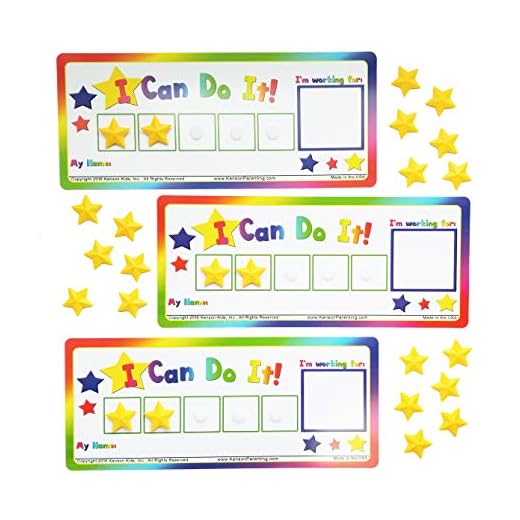


Best Overall: Kenson Kids "I Can Do It!" Token Board, 3 Pack
Dry-erase goal box lets parents set a specific screen-time earning target per child, with 5 star slots making progress toward extra tablet time visibl
- Comes with 3 boards so each kid in the house gets their own without buying multiples
- Dry-erase goal box lets you change the target task without buying a new chart
- Magnetic backing sticks to the fridge without tape or tacks
- Star slots are big enough for toddlers to place magnets without frustration
- 5 stars per board is a short cycle — fast earners will want more slots
- Dry-erase surface smudges if wiped before it fully dries
- No physical token to hold onto between earning and cashing in
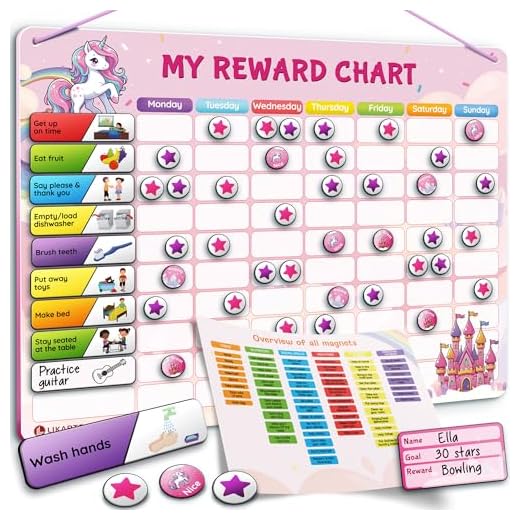
Best Premium: LIKARTO Magnetic Reward Chart with 280 Magnets
280 magnets, including blank ones, let you build a fully custom screen-time earning chart, and the layout works for two siblings sharing one device.
- 280 magnets means you can build separate weekday and weekend earning schedules
- Blank magnets let you write in specific screen-time apps or shows as rewards
- Visual schedule layout is genuinely better for kids who need routine predictability
- Sturdy enough to survive two siblings using it simultaneously
- Most expensive board in this lineup
- 280 pieces is overwhelming to set up on day one
- Pink color scheme won’t appeal to every household
Best Budget: 66 Pack Classroom Incentive Chart with 2080 Star Stickers
2,080 star stickers across 66 charts make it cheap to track screen-time earning stickers per task for multiple kids without buying constant refills.
- 2,080 stickers means you won’t run out mid-school-year
- 66 separate charts cover a classroom or several kids at home without reprinting
- Cheapest way to test whether a token system even works for your kid before spending more
- Stickers give a satisfying physical action that magnets don’t
- Paper charts wear out and tear faster than magnetic boards
- Stickers are one-time use, so a finished chart can’t be reset and reused
- No magnetic backing means you need tape or a clipboard to display it
Best for Token Trading: Large 11" DIY 80 Tokens Magnetic Reward Jar
80 physical mica tokens let kids drop earned tokens into a jar and trade them in for screen time, making the save-and-cash-in process tangible.
- Physical drop-in-jar mechanic is the most tangible option for younger kids
- 80 tokens is enough supply that losing a few doesn’t break the system
- Doubles as a potty-training or general chore chart outside of screen time
- Jar fills up visibly, giving a satisfying sense of accumulation
- Small tokens are a choking hazard for households with toddlers under 3
- Tokens get lost around the house more easily than a fixed chart
- Jar takes up more counter or wall space than a flat board
Runner Up: Reward Jar for Kids with Star Tokens
Star tokens accumulate in a jar built around screen-time rules, so kids see exactly how many tasks stand between them and their next round of playtime
- Simple setup with no dry-erase writing or complex rules required
- Star tokens are more durable than paper stickers and reusable
- Works equally well as a classroom tool or a home screen-time system
- Priced in the middle, making it an easy first purchase to try the concept
- Fewer customization options than the LIKARTO or Kenson boards
- Newer product with a shorter track record for long-term durability
- Jar format takes more space than a wall-mounted board
Best for Daily Routines: Melissa & Doug Magnetic Responsibility Chart & Kids Calendar
Two dry-erase boards track up to seven daily goals at once, ideal for linking screen time to a full routine like homework and chores completed first.
- Calendar component helps kids understand weekly patterns, not just single-day goals
- Wooden construction feels sturdier and more durable than plastic or paper alternatives
- Tracks up to 7 goals, so screen time can be the last box checked after chores and homework
- Trusted brand name that resells well if you outgrow it
- No token or star pieces included — you’re writing directly on the board
- Bulkier than a single flat token chart, needs more wall space
- Best suited to kids who can already read the listed tasks
Side-by-side comparison
|
Best Overall
Kenson Kids “I Can Do It!” Token Board, 3 Pack. Co
|
Best Premium
LIKARTO Magnetic Reward Chart for Kids with 280 Ma
|
Best Budget
66 Pack Classroom Incentive Chart with 2080 Star S
|
Best for Token Trading
Large 11" DIY 80 Tokens Magnetic Reward Jar Kids P
|
Runner Up
Reward Jar for Kids with Star Tokens, Positive Rei
|
Best for Daily Routines
Melissa & Doug Magnetic Responsibility Chart & Kid
|
|
|---|---|---|---|---|---|---|
|
|
|
|
|
|
|
|
| System Type | Magnetic board + goal box | Magnetic board, 280 pieces | Sticker chart | Token jar | Star-token jar | Dry-erase board + calendar |
| Recommended Ages | 3-10 | 3-9 | All ages | 3+ | 3+ | 4+ |
| Good for Multiple Kids | Yes | Yes | Yes | No | No | No |
| Physical Tokens | No | Yes | Yes | Yes | Yes | No |
| Price | $19.94 | $27.95 | $6.98 | $19.99 | $13.99 | $17.19 |
| BUY NOW | BUY NOW | BUY NOW | BUY NOW | BUY NOW | BUY NOW |
What to look for in Screen-Time Reward Charts and Token Systems for Kids
What age should I start using a screen-time token system?
Most of these systems work starting around age 3, once a kid can understand that completing a task now leads to a reward later. Physical token and jar systems tend to work best for the youngest end of that range since the concept is more concrete than a chart with abstract stars.
Should each kid have their own chart or share one?
Give each kid their own chart or set of tokens. Shared charts almost always lead to disputes over whose star or token belongs to whom, which undermines the whole point of the system. A 3-pack like the Kenson board or a jar system with distinct token colors per kid solves this cleanly.
How many tasks should be required before earning screen time?
Start small — 3 to 5 tasks or stars for younger kids, more for kids over 7 who can handle delayed gratification. If the goal takes too long to reach, kids lose interest in the chart within a week; too short and it stops feeling like an earned reward.
Do magnetic charts or sticker charts last longer?
Magnetic charts last significantly longer since the pieces are reusable and the board itself is typically wipeable or wooden. Sticker charts are cheaper upfront but become single-use once filled, so you’ll need to reorder or reprint them if you want to keep using the system.
The bottom line
- Kenson Kids 3-Pack Token Board — best overall pick for families with multiple kids needing individual charts
- LIKARTO 280-Magnet Chart — best premium option for building a fully custom, routine-heavy system
- 66 Pack Classroom Incentive Chart — best budget way to test whether a token system works before spending more
- Large 11" DIY 80 Tokens Magnetic Reward Jar — best for kids who need a tangible, physical earning mechanic
- Reward Jar for Kids with Star Tokens — solid runner-up jar system at a fair mid-range price
- Melissa & Doug Magnetic Responsibility Chart — best for tying screen time to a full daily chore and homework routine
The Kenson 3-pack is the easiest starting point for most households with more than one kid, while the LIKARTO earns its premium price if you need a system flexible enough for a genuinely complex routine. If you’re not sure a chart system will stick with your kid, the sticker pack costs less than a coffee run and lets you find out.